Cleaning client onboarding turns an accepted quote into a service the team can deliver consistently. Confirm scope, price, access, safety, communication, billing and the first visit before adding a customer to the recurring schedule.
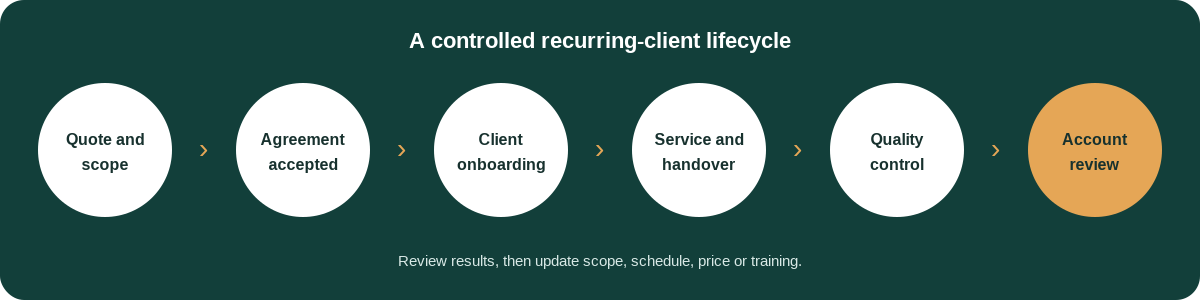
Stage 1: confirm the sale
- customer and service address are correct
- accepted quote matches the final scope and frequency
- taxes, add-ons, discounts and payment timing are clear
- terms, privacy notice and cancellation policy are supplied
- acceptance date and policy version are recorded
Do not let the sales conversation remain only in texts or memory. Store the final scope with the customer record.
Stage 2: collect service details
- property layout, priority rooms and exclusions
- surface or product restrictions
- pets, occupants and relevant accessibility needs
- parking, building entry and alarm instructions
- key, lockbox or smart-lock process
- known hazards or specialist work outside scope
Use the cleaning quote checklist to capture the information before pricing. If new facts materially change time or risk, revise the quote before the first visit.
Stage 3: protect access information
Assign a customer ID rather than placing a full address on a loose key tag. Limit access codes to workers who need them, use a secure system and record returns or revocation when service ends.
Collect only necessary personal information. Define who can view it, why it is retained and when it is deleted under the privacy rules that apply to your market.
Stage 4: create the service record
| Record | Minimum information |
|---|---|
| Service profile | Scope, frequency, price and estimated labour-hours |
| Property notes | Access, parking, pets, surfaces and exclusions |
| Schedule | Zone, recurrence, arrival window and next visit |
| Billing | Invoice contact, payment method and due rule |
| Communication | Preferred channel and authorized contacts |
| Quality baseline | Priorities and any agreed first-clean difference |
Stage 5: brief the assigned cleaner
Provide the current checklist, access instructions, time allowance, product restrictions, pet notes and escalation contact. Do not forward unrelated customer data.
Use the job handover checklist whenever responsibility moves between the estimator, scheduler and cleaner.
Stage 6: confirm the first visit
Send a concise confirmation containing:
- date and arrival window
- agreed service and add-ons
- price and payment timing
- access and pet preparation
- how to request a change
- link to accepted terms and cancellation policy
Stage 7: review after the first clean
Within the agreed follow-up period, compare estimated and actual labour-hours, record scope surprises and ask one focused feedback question. Update the permanent service profile before the next visit.
Do not promise a recurring flat price until the first-clean evidence supports it. If the home requires a different ongoing scope, explain the reason and obtain agreement.
Onboarding completion test
A client is fully onboarded only when:
- the customer can state what is included and when the team arrives
- the cleaner can access and complete the job without guessing
- the scheduler can see the next appointment and capacity used
- the business can invoice and handle a change consistently
Frequently asked questions
Should onboarding be automated?
Automate reminders, form collection and record creation after the process works manually. Keep human review for unusual scope, hazards, access and pricing changes.
What should never be in general crew notes?
Avoid unnecessary identity, financial, medical or family details. Share only information required to perform the service safely and correctly.
Place the client on the correct zone day using the recurring cleaning schedule, then use the first visit to validate the operating assumptions.
Worked onboarding handoff
An estimator agrees to a fortnightly service and notes that the customer wants fragrance-free products. The scheduler assigns the correct zone day, but the product restriction remains in the estimator’s messages. The cleaner arrives with the normal kit and cannot follow the requirement.
The fix is a required field in the master service profile and a completion gate: the first visit cannot be assigned until access, product restrictions, scope, price and customer confirmation are present. The handover checklist then transfers only the necessary information to the cleaner.
Onboarding status board
| Status | Exit condition |
|---|---|
| Quote accepted | Scope, price and terms recorded |
| Setup incomplete | Access, billing and property details collected |
| Ready to schedule | Crew, capacity and confirmation prepared |
| First visit complete | Actual time and issues recorded |
| Recurring active | Profile updated and next visit confirmed |
Common onboarding failures
- treating payment as the only completion requirement
- leaving property restrictions in private messages
- scheduling before access is confirmed
- giving the crew unnecessary personal information
- failing to update the estimate after the first clean
Check the recurring estimate after onboarding
Follow the first-to-recurring pricing case to separate baseline work from maintenance and compare actual worker-hours before revising future estimates.